When a deposit makes sense
A deposit does not replace confirmations and reminders. If you do not have those yet, start there: they cost less and put no barrier in front of the client. We cover what to set up first in how to reduce no-shows.
A deposit helps where one no-show is expensive and the slot is hard to fill at the last minute:
- Long appointments that take half a day of a specialist's time.
- Services where you order materials in advance.
- Evening and weekend slots that are booked a week or more ahead.
- Clients who have already missed a visit without notice.
For short services, a slot is easy to give to someone on the waiting list. There a deposit usually does more harm than good.
The legal side in the UK and the US
In the UK, terms in a consumer contract must be fair under Part 2 of the Consumer Rights Act 2015. An unfair term is not binding on the consumer. Schedule 2 to the Act lists terms that may be regarded as unfair. One is a term about keeping sums paid when a consumer decides not to go ahead.
Another is a term requiring a consumer who fails to keep to the contract to pay a disproportionately high sum. The CMA explains how it applies these rules in its unfair contract terms guidance. A deposit far larger than your likely loss is therefore a risk.
In the US, rules on deposits and cancellation fees vary by state. Use plain words like "deposit" for clients, and have a local adviser check the wording in your terms.
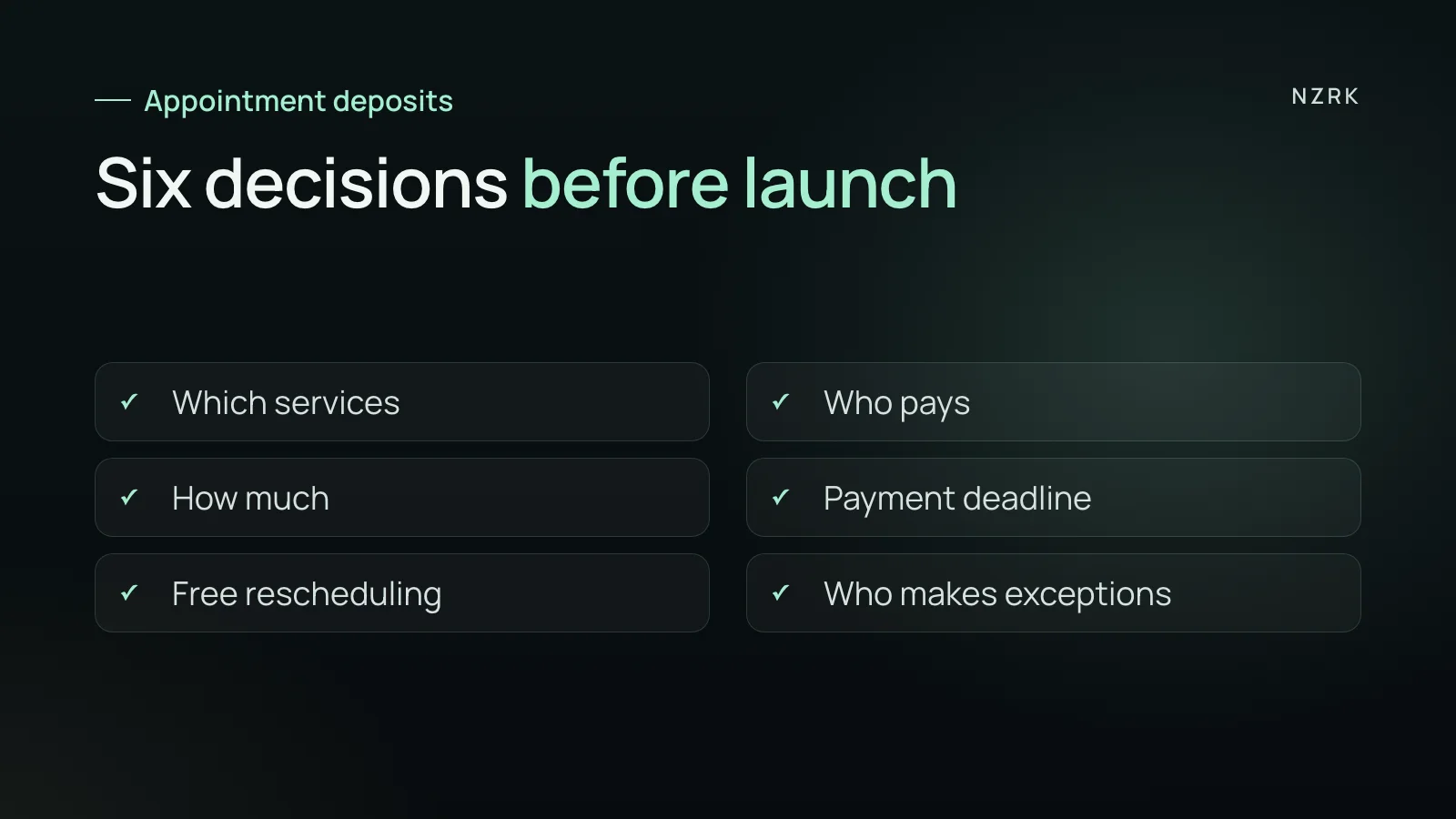
Six decisions before you start
- Services. The list of appointments the policy covers. Everything else is booked as before.
- Who pays. All clients, new clients only, or only those who have already missed a visit without notice.
- Amount. A fixed sum or a share of the price. A sensible guide is no more than the loss from one empty slot, not the full price. You can work that out with the cost of no-shows.
- Payment deadline. How many hours the slot is held without payment and what happens after that.
- Rescheduling and cancellation. How much notice a client needs to move without losing the deposit. The deposit then moves to the new time.
- Exceptions. Who can make them and where they are recorded, so the policy does not depend on who is at the front desk.
Policy template
The policy should fit into four sentences a client understands on first reading. For example:
"For appointments of two hours or more, we hold your time once a deposit is paid. The deposit goes toward the cost of your visit. You can reschedule free of charge until the same time on the day before your visit. The deposit then moves to the new time. If you cancel later or do not attend, the deposit is not refunded."
Use your own hours, notice period and service list. What matters is that the same text appears on your website, in the booking confirmation and in what the front desk says. The last sentence, saying the deposit is not refunded, is the one the law looks at most closely. Have an adviser check it.
What to say to clients
Disputes often start when a client learns about the deposit after booking. Mention it straight away and calmly, as a normal condition:
- On the phone: "For this treatment we hold the time with a deposit, which goes toward the price. I'll text you a payment link, and the slot is yours until 6 pm."
- In the confirmation: "You're booked for Thursday at 2 pm. To secure the time, please pay the deposit by 6 pm using the link below. You can reschedule free of charge until Wednesday at 2 pm."
- After payment: "We've received your deposit and the time is yours. We'll remind you the day before."
- If no payment arrives: "The slot is still held for you until 6 pm. If another day works better, just reply and we'll find one."
The policy should sound the same in every channel: on the website, in messages and on the phone. Not sure where requests stop short of a booking? Take the free AI audit: it shows where requests get lost and what to fix first.
Rescheduling, cancellations and disputes
- The client reschedules in time. The deposit moves to the new time, no questions asked.
- The client cancels late. The policy applies. If you make an exception, record it on the client's profile so a second exception does not quietly become the new rule.
- You cancel. Refund the deposit straight away or offer another time of the client's choice. This is about trust.
- The client objects to the policy. Offer a shorter service without a deposit, or a slot that is easy to refill.
How to check after a month
- How many no-shows these services had before and after the policy.
- How many people declined to book because of the deposit.
- How many exceptions were made and why.
- Whether bookings from new clients dropped.
If no-shows fell and bookings did not, the policy works. If new clients started to decline, soften it: keep the deposit only for clients who have missed a visit before.
Should every client pay a deposit?
You can ask everyone, but for short services it often puts off more people than it saves slots. Start with long appointments and clients who have missed visits before.
Can I keep the deposit if the client does not show up?
It depends on what the client agreed to and on the law where you operate. In the UK the term must be fair under the Consumer Rights Act 2015. A deposit far above your likely loss is a risk. In the US it depends on state law. Have an adviser check your wording.
How do I take a deposit without a card machine at the desk?
A common way is a payment link in the booking confirmation. Put the payment deadline and the rescheduling rule in the same message.