Why "appointments times average bill" misleads you
A simple formula you will often see online goes like this: number of appointments, times the no-show rate, times the average bill. It measures revenue you did not collect. But missed revenue is not the same as loss.
When a client does not show up, you also save some money. Supplies stay on the shelf, and commission paid only for completed work is never earned. On the other hand, rent and salaried staff cost the same whether the client came or not. So the honest loss per slot is smaller than the bill but bigger than zero, and that is the number worth tracking.
The second flaw of the simple formula is that it ignores what happens after the no-show. Your front desk refills some slots from a waitlist. And some clients who miss a first visit never come back, taking the rest of their treatment plan with them.
The four-step formula
- Step 1. No-show rate: no-shows in a month divided by all appointments in that month. A no-show is a client who did not come and did not warn you. Or one who cancelled too late for the slot to be refilled. The owner sets that cut-off, for example less than a day.
- Step 2. Loss per slot: average bill minus variable costs of the service. Variable costs are supplies and any pay that is earned only for completed work. If supplies were already prepared and wasted, do not subtract them.
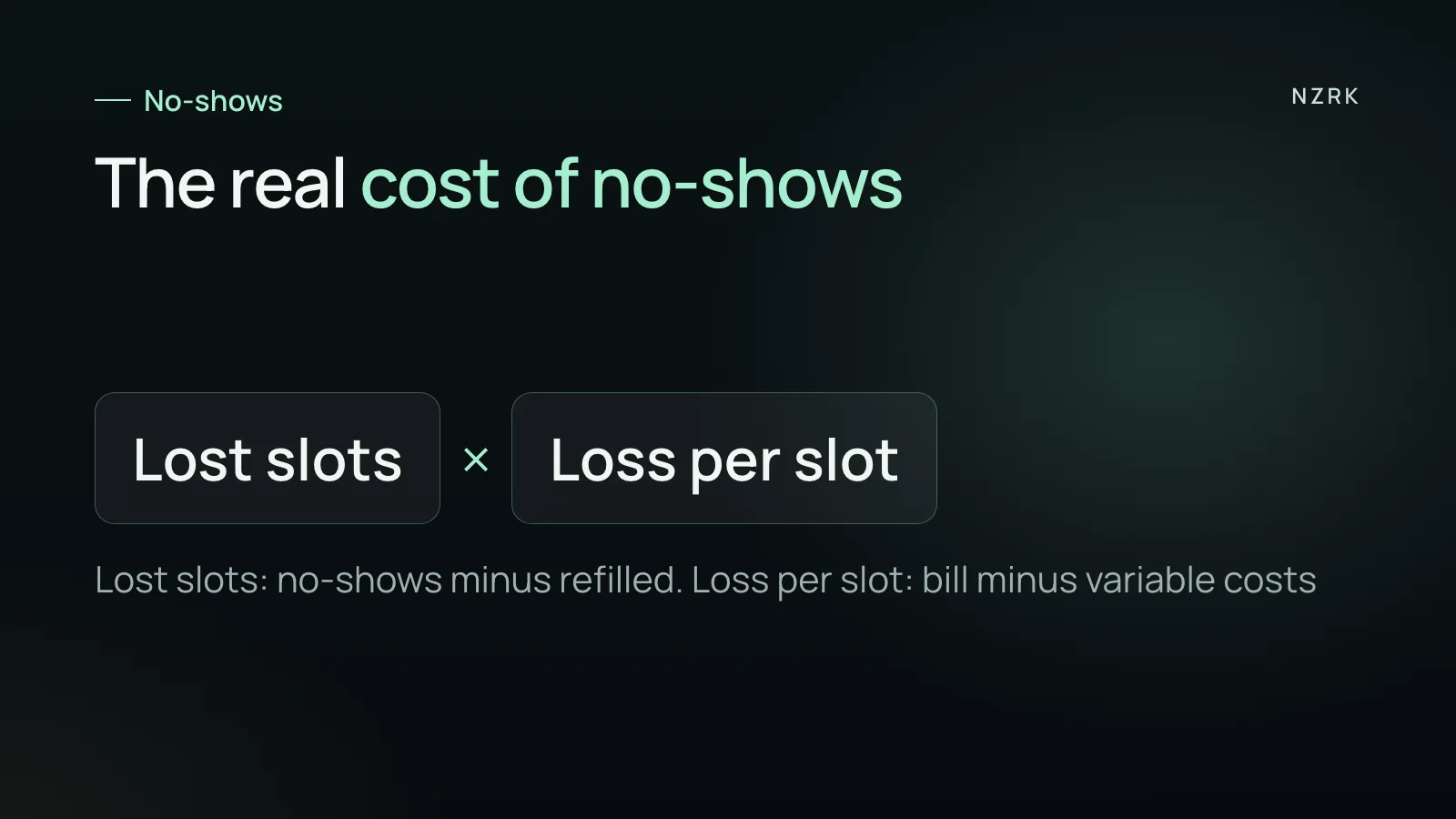
- Step 3. Monthly loss: number of no-shows minus refilled slots, times the loss per slot.
- Step 4. Hidden loss: how many no-shows were first visits or part of a treatment plan, and what share of those clients never returned. Keep this as a separate line, not mixed into step 3.
With a booking log, the four steps need no special tools. If you do not track no-shows yet, start today: date, service, new or returning client, warned or not, slot refilled or not.
Where to get the numbers
- Appointments and no-shows: your practice management system, online booking tool or front desk log for a full month.
- Average bill: service revenue divided by the number of services delivered in the same month.
- Variable costs: supplies per service and how your providers are paid.
- Refilled slots: a note in the log that someone else took the freed time.
- Follow-up visits: how many times an average client returns after a first visit.
Do not guess the average bill. Calculate it for the same month as the no-shows, or the formula will give you a number you will not trust yourself.
Break-even test: will a fix pay for itself
Every no-show fix costs money or time. Think of a reminder service, front desk hours on confirmation calls, or a deposit policy that puts some clients off. To decide whether it is worth it, work out the break-even point.
Break-even point: monthly cost of the fix divided by the loss per slot. The result is how many no-shows a month the fix has to prevent to pay for itself. If that is two or three and you have dozens, the fix will most likely pay off.
Check it against your log a month later. Count only no-shows whose slots you would not have refilled anyway. If it has to prevent more no-shows than you actually have, it will not pay off, however good it looks.
Once you know the cost, the next question is how to bring it down. We collected seven ways, from confirming right after booking to tracking no-shows and their reasons, in how to reduce no-shows.
How to read the result
- High no-show rate and few refilled slots: start with a waitlist and an easy way to reschedule.
- Most no-shows are new clients: check the confirmation right after booking and the reminder the day before.
- Lots of late cancellations: give clients a convenient way to warn you early instead of at the last minute.
- The loss is small compared with revenue: skip complicated policies, reminders are enough.
No-shows are often just one of the places where a business leaks money. Missed calls and unanswered messages cost money too, but few businesses write them down. To hear how this sounds in a live call, try the AI receptionist demo. LumaDent is our demo dental practice, so ask anything.
Worked example
Should cancellations count as no-shows?
Only late ones, when the slot could no longer be refilled. Set the cut-off yourself, for example less than a day before the visit. Keep it the same every month.
Why not count the full bill?
Because you avoided some costs: supplies were not used and pay for completed work was not earned. The full bill overstates the loss, and decisions based on it will be off.
How often should I calculate the cost of no-shows?
Once a month, using the same rules. That way you see whether a fix worked instead of guessing.
What if I have no no-show log?
Start one today: date, service, new or returning client, warned or not, slot refilled or not. In a month you will have every number the formula needs.