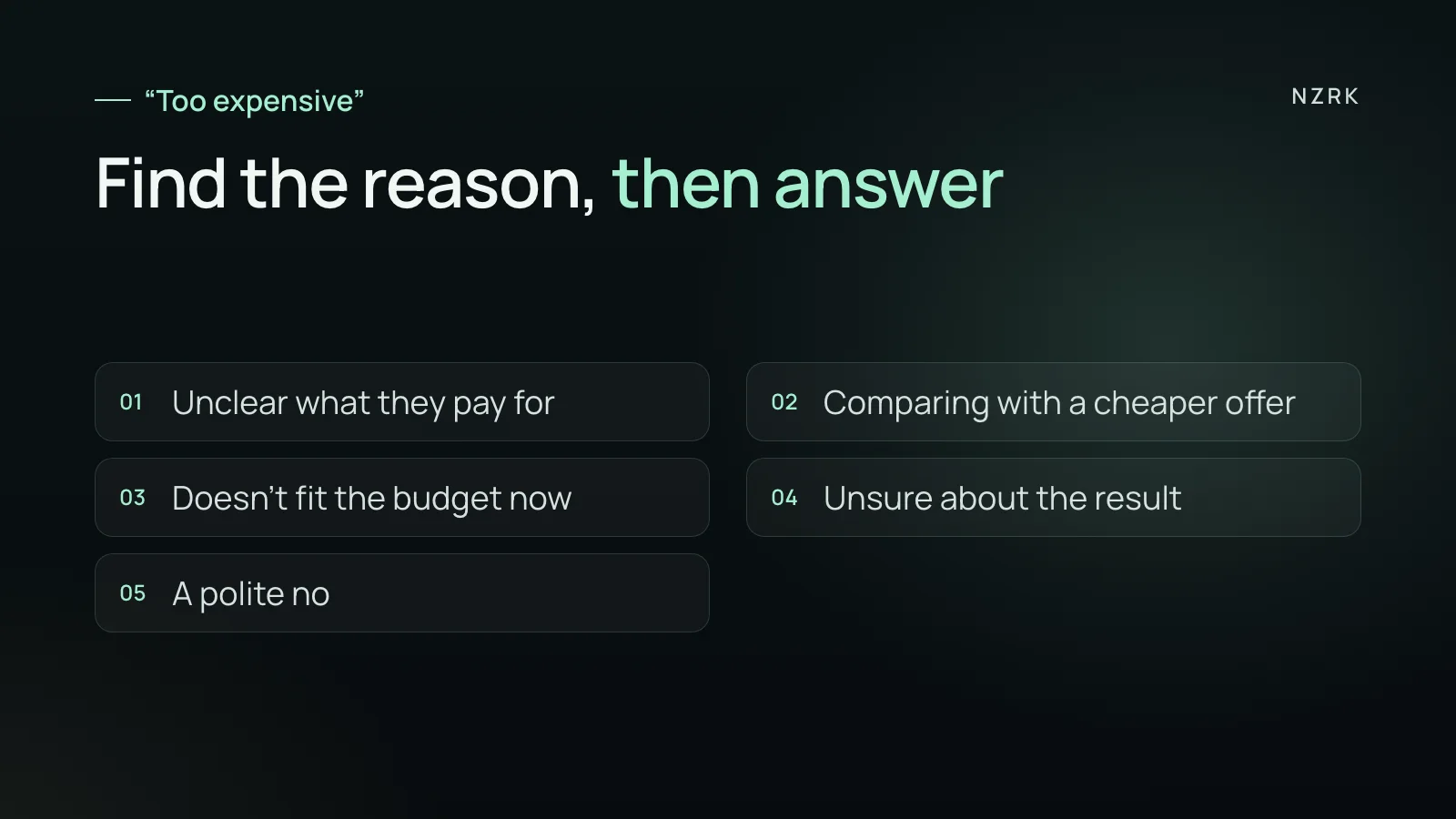
Why one answer to “too expensive” doesn’t fit every case
“Too expensive” doesn’t tell you what is actually wrong. One person can’t see what the total is made of. Another saw a lower price at the shop down the street. A third wants it, just not this month. Give all three the same answer and your answer will fit at most one of the three.
So the front desk’s first job is not to persuade but to understand. That takes one question and a few seconds.
One question before you answer
Acknowledge the feeling, not the verdict, and ask an open question. Phrases that sound calm and carry no pressure:
- “I understand, it’s a noticeable amount. What are you comparing it with: another practice, or the budget you had in mind?”
- “Which part feels expensive: the whole amount or one part of it?”
- “What matters most to you here: the price, the result or the timing?”
Avoid “Why do you think it’s expensive?”: it sounds like a challenge. Let them finish without interrupting. The reason is in that answer.
Five kinds of “too expensive” and what to say
- They don’t see what they are paying for. Break the price down, naming only what is really included. Say “there are no extras on top” only if that is true. For example: “That covers the assessment, materials, the technician’s time and a follow-up visit.”
- They are comparing you with a cheaper offer. Don’t knock the competitor. Name a difference they can check themselves: “It’s worth asking whether their price includes a warranty and which parts they use. If it’s the same, it’s a fair comparison.”
- It doesn’t fit the budget this month. If the service can be split, offer a smaller first step or stages: “Let’s start with what matters most. We can schedule the rest for next month.” Only mention payment plans if you actually offer them.
- They aren’t sure about the result. Show how they can check, using what you really offer. Suggest a consultation before paying and photos of past work shared with clients’ permission. Add warranty terms in writing if you have one.
- It’s a polite no. Don’t push. Leave the door open: “I can text you the quote so you have it when you decide.”
Other tricky moments on the phone are covered in our front desk phone script. That includes “I’ll think about it” and two calls at once.
A four-step script
- Acknowledge the feeling: “I understand, it’s a noticeable amount.”
- Ask one open question to find the reason.
- Answer that reason, not every possible one.
- Suggest a concrete next step: a consultation or a first stage with a date. For a polite no, offer a written quote with no pressure.
When “how much?” arrives by message
In Instagram DMs, WhatsApp or text, the price question can come first, before the person has said what they need. A bare number gives them only one thing to do: compare it with other numbers. Answer with a “from” price, what it depends on, and one question instead.
Template: “Hi, thanks for asking. The price depends on [what drives the price], starting from [lowest price]. To give you an exact figure, could you tell me [one question]? Or we can book you a consultation on [day and time].”
This kind of question is better not left waiting. If the reply comes hours later, the person may already have messaged someone else. To hear how this sounds in a live call, try the AI receptionist demo. LumaDent is our demo dental practice, so ask anything.
What not to do
- Don’t discount straight away. The customer may conclude that one word moves the price, and say it again next time.
- Don’t argue that it isn’t expensive. You can’t disprove a feeling; you can only explain what they get.
- Don’t criticize competitors. It can sound defensive and doesn’t build trust.
- Don’t quote a price without saying what it includes.
- Don’t invent urgency like “this price is only good today” unless it is true.
When a discount makes sense
Lower the price only when the customer gives something in return. That can be a smaller scope, an off-peak slot, payment upfront or a package. Then you are changing the terms, not cutting the price of the same thing. Before you set rules like these, check what you actually earn on the service. Our guide on how to price a service shows the calculation.
Should I give a discount if the customer asks for one directly?
Preferably in exchange for something: a smaller scope, a different time, payment upfront or a package. A discount for the same thing can train customers to haggle.
What do I say to “your competitor is cheaper”?
Don’t criticize them. Ask what their price includes and name a difference the customer can check: parts or materials, warranty, what is included.
Should I give prices by message?
Yes, as a “from” price or range with what it depends on. Add one question so you can give an exact figure. A bare number with no context leaves the customer one thing to do: compare it with other numbers.
How do I train the front desk to handle “too expensive”?
Write the five answers from this article for your own services in a shared document. Role-play them in pairs regularly: one plays the customer, the other the front desk.