Cost, margin and markup in plain words
The cost of a service is everything you spend to deliver it to one client. That includes supplies, but also a share of rent, team pay and marketing.
Margin tells you how much of the price you keep. Formula: margin = (price - cost) ÷ price.
Markup tells you how much you added on top of cost. Formula: markup = (price - cost) ÷ cost.
The profit in dollars is the same in both. The only difference is what you divide it by: price or cost. So on any profitable service, margin is always lower than markup.
Step 1. Add up the direct costs of one service
Direct costs only show up when the service actually happens. No client, no direct cost.
- Pay for the stylist, barber, tech or clinician, if they earn a commission or a set amount per visit.
- Supplies and consumables: color, numbing cream, gloves, single-use towels, oil.
- Card processing or online payment fees.
- Anything else tied to that service: sterilization, laundry, disposal.
Use real numbers from invoices and receipts, not memory. Count supplies per treatment, not per box.
Step 2. Spread your fixed costs across visits
Fixed costs arrive every month, even when the book is empty. They are the ones owners forget, and they are where a price quietly eats your profit.
- Rent and utilities.
- Front desk and anyone else on a fixed wage.
- Booking software, CRM, phone line, website.
- Marketing and ads.
- Equipment repairs and replacement over time.
- Bookkeeping, bank fees and other monthly services.
Add up one month and divide by the number of visits in that same month. Use actual visits, not the ones you hoped for. If services vary a lot in length, divide by chair or room hours instead.
Example: pricing a haircut at a barbershop
An example with made-up round numbers, just to show the math. Swap in your own.
In the UK the math is the same in pounds. Only the numbers you plug in change.
The classic mistake: using markup when you meant margin
Keep these four conversions close so it does not happen.
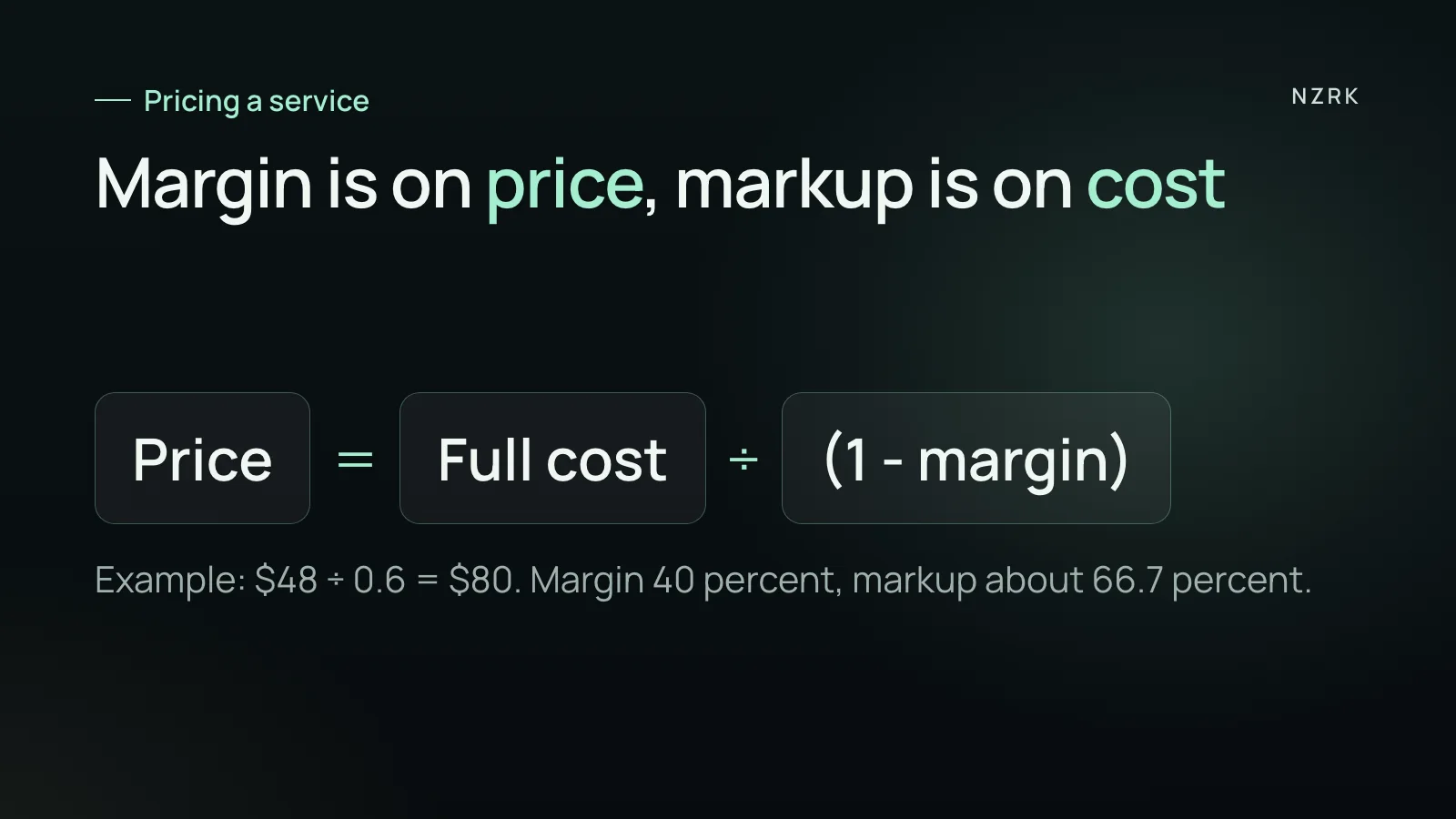
- Price from margin: cost ÷ (1 - margin).
- Price from markup: cost × (1 + markup).
- Markup from margin: margin ÷ (1 - margin). A 40 percent margin equals about a 66.7 percent markup.
- Margin from markup: markup ÷ (1 + markup). A 50 percent markup gives about a 33.3 percent margin.
How no-shows and discounts eat your margin
Fixed costs do not shrink when a client fails to show up. They just get split across fewer visits.
To keep the same monthly profit, you need about 467 visits instead of 400. Fixed costs stay the same, so count what each discounted visit earns above its direct costs. So only discount when you know where the extra clients will come from.
Confirming right after booking and reminding before the visit can cut no-shows. We collected the methods in how to reduce no-shows. You can hand that routine to a system. The AI Receptionist books the client, sends a confirmation and sends a reminder before the visit.
Check your price against the market and the value
The formula gives you a floor. Below it, every visit loses money. The market may still pay more or less.
- Look at what five to seven nearby competitors charge for a similar service.
- If you are higher, spell out what the client pays for: experience, products, service, easy booking.
- If the market pays less than your cost, price is not the problem. Look at your costs or how full your book is.
- Raise prices in small steps and watch whether bookings drop.
Money also leaks before a client ever hears your price, for example in calls and messages nobody answered. More on that in where your business loses customers.
A one-page pricing template
- Your list of services and the direct costs of each.
- Last month's fixed costs as one total.
- Actual visits in that same month.
- Fixed cost per visit.
- Full cost of each service.
- Target margin and price from cost ÷ (1 - margin).
- Nearby competitor prices for comparison.
Update it every quarter, or whenever rent, team pay or supply prices change. Taxes sit on top of this math. In the UK, VAT-registered businesses charge VAT on most services, so work out margin on the price before VAT. In the US, whether sales tax applies to a service depends on the state. Check the details with your accountant.
Want to see where bookings and money slip away in your business? Take the free audit: five questions and a plan with numbers.
What is a good margin for a service business?
There is no single number. It depends on your industry, location and how you count cost. Compare against your own past months and local prices, not someone else's averages.
What is the difference between margin and markup?
Margin divides profit by price, markup divides it by cost. A 40 percent margin equals about a 66.7 percent markup.
Should I include my own time in the cost?
Yes, if you work in the chair or run the business every day. Otherwise profit looks bigger than it is, because your time counts as free.
How often should I review my prices?
At least once a quarter, and whenever rent, pay rates or supplies change. Recalculate your cost even if you keep the price the same.