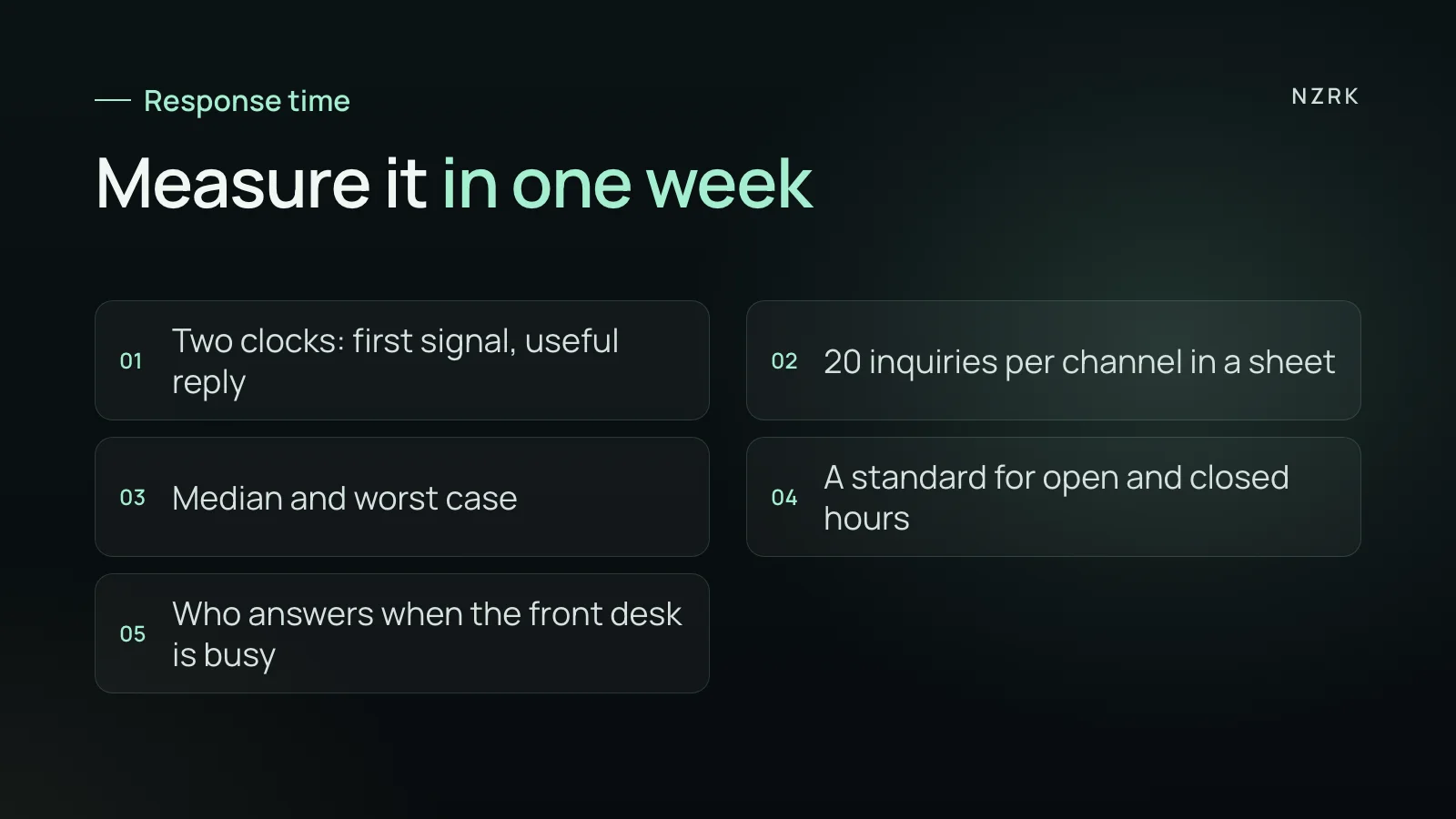
What to measure: two clocks
The first clock runs from the inquiry to the first sign that someone has seen it. That can be an auto-reply or a short note such as “got your message, we will reply by 10:30”. It tells you whether the customer was left in silence.
The second clock runs until a useful reply: a price, an open slot, the terms or a clear next step. That is what the customer is actually waiting for. An empty auto-reply stops the first clock, while the second one keeps running.
Calls work the same way. The first clock is whether anyone picked up. If the call was missed, the second clock shows how long it took to call back and actually reach the person.
How to measure it in a week without new software
- Step 1. Set up a spreadsheet with six columns: channel, time of inquiry, first acknowledgement, useful reply, who replied, open or closed hours.
- Step 2. Log the last twenty inquiries from each channel: phone, text messages, WhatsApp, Instagram, the website form and email. The timestamps are usually already in your inbox, your messaging apps and your phone system call log. If a channel shows no timestamp, write it down by hand.
- Step 3. Use the median, not the average. Sort the waiting times from shortest to longest and take the value in the middle. With an even number of inquiries, take the average of the two middle ones. One late-night message answered the next morning distorts the average badly and barely moves the median.
- Step 4. Write down the worst case of the week and its cause: lunch, a staff meeting, a day off, two calls at once.
- Step 5. Run a mystery inquiry. Ask a friend to text and call at different times, including lunchtime and after closing, and note what they received.
The median shows how you usually reply. The worst case shows where customers actually slip away. You need both numbers, because either one on its own is misleading.
What standard to set
There is no single official benchmark for small businesses. The targets you find in vendor blogs vary a lot, so treat them as a seller's opinion rather than a rule. It is better to set your own standard based on how your customers choose.
If people contact several businesses at once and book with whoever answers first, minutes matter. If a customer plans a month ahead and compares options, a few hours can be fine. The reply just has to be complete.
- A separate standard for opening hours and closed hours. At night an honest acknowledgement and a useful reply in the morning are enough.
- A separate standard for each channel. A call, a text and a web form come with different expectations.
- The standard is written down and known to the whole team, not just the owner.
- The standard is checked every week: the median and the worst case in the same spreadsheet.
Who replies when the front desk is busy
Delays are often not about effort. They happen because the receptionist is on a call, checking someone in or on a break, and messages wait. So the standard has to rest on simple rules, not on good intentions.
- A named person on duty for peak times: everyone knows who checks messages at lunch and during the morning rush.
- First to see it replies: anyone on the team sends the first reply from a template and hands it over.
- Missed call: a short text right away and a call back within your standard.
- When closed: an auto-reply with an honest time when a person will answer, asking for the service and a preferred day.
Three first-reply templates
Text or chat during opening hours: “Hi, this is [name] at [business]. Happy to help with prices and availability. Which service are you after, and which day works for you?”
When closed: “Thanks for your message. We are closed at the moment and the front desk will reply by [time] on [day]. If you share the service and a day that suits you, we can offer a time straight away.”
After a missed call: “Hi, you called [business] and we could not pick up. We will call you back by [time], or reply here with what you need.” Promise a call-back only if it will happen. For more on handling these calls, see our guide to missed calls.
A template does not replace a useful reply. It only shows the customer they were heard and collects the details, so the second reply can be useful right away. We cover how to write the reply itself in our guide on replying to Instagram DMs.
What to do with the results
- The median is within your standard but the worst case is far outside it: the problem sits in specific hours. Check when the longest waits happen and put someone on duty then.
- Messages sent while you are closed wait longest: add an honest auto-reply and decide who handles overnight messages first.
- One channel is clearly slower than the rest: sometimes nobody feels it is theirs. Give that channel to a named person.
- The mystery inquiry got no price and no time: rewrite the templates so the first reply moves towards a booking.
A spreadsheet is enough for the first week. To hear how this sounds in a live call, try the AI receptionist demo. LumaDent is our demo dental practice, so ask anything.
Example standard
Does an auto-reply count as the first response?
It only stops the first clock: the customer knows they were heard. It is not a useful reply. Measure the second clock until the person gets a price, a time or a clear next step.
Why the median and not the average?
A few very long waits, such as overnight ones, pull the average up sharply. The median shows how you usually reply, and you still write down the worst case separately.
What if we only have one receptionist?
Split the standard into business hours and closed hours, agree who covers lunch, and use first-reply templates. Some routine answers can be automated so the person can focus on the harder inquiries.
Do we need a CRM to measure response time?
Not for the first week. The timestamps are usually already in your messaging apps, call log and email, and a six-column spreadsheet gives a clear enough picture.