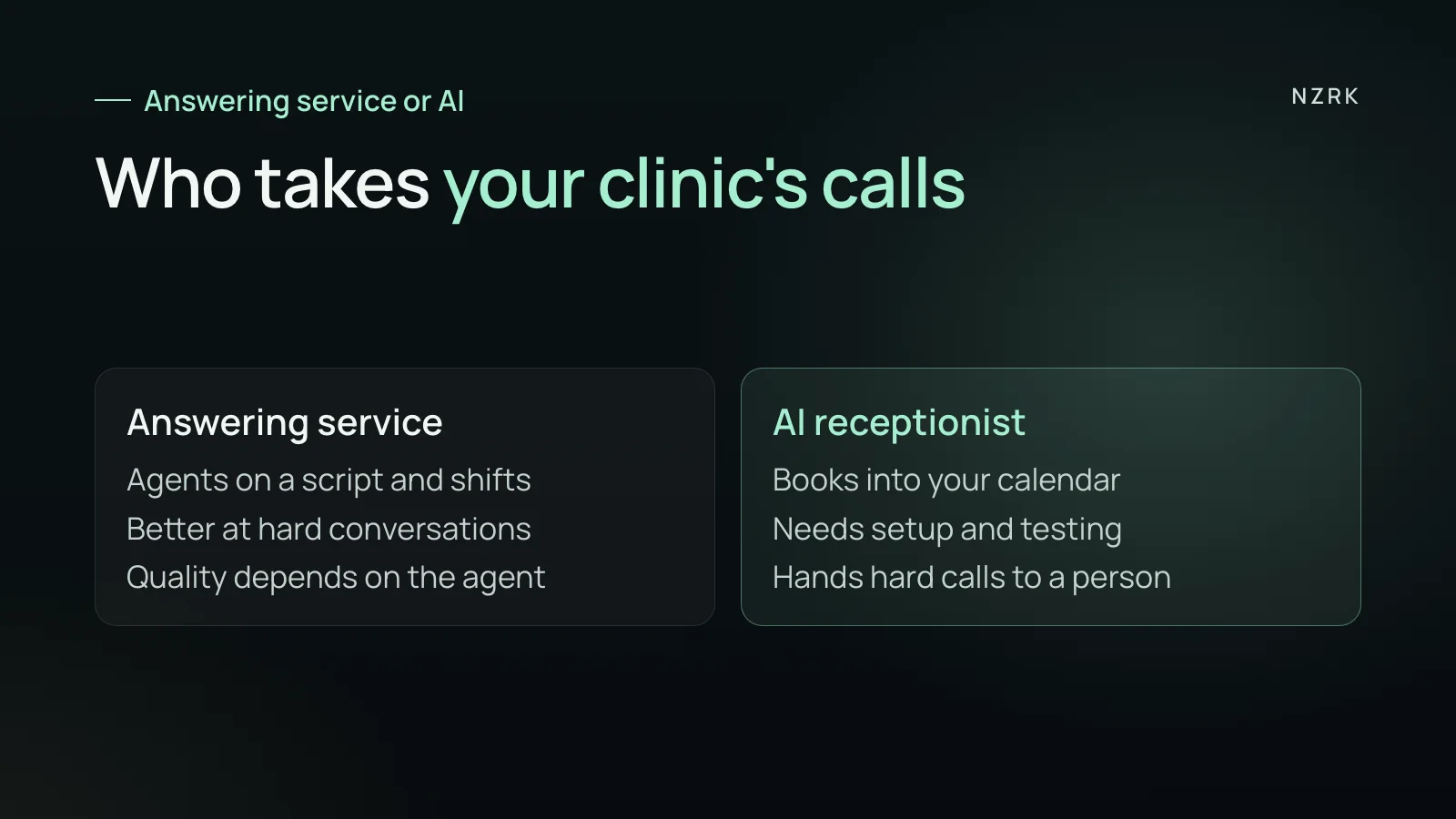
What you are actually buying
The names sound alike, but these are different things. It helps to spell out what you really get.
- Answering service or call center: a team of agents on the vendor side, shifts, a script, training and quality checks. Agents may serve several clients at once (ask whether you get a dedicated team). They know your practice from the script and notes you provide.
- AI receptionist: a configured system that understands natural speech and answers from your practice knowledge base. It works with your calendar and hands the call to a person by clear rules. It needs setup and upkeep, but it answers the same way at any hour.
Either way, your practice stays responsible for what the patient heard. So compare the outcome of the call, not the technology.
8 points of comparison
- Hours: a call center covers the shifts in your contract. An AI receptionist answers whenever you set it to, with no gaps between shifts.
- Peak-hour queues: with a call center it depends on how many agents are on shift. An AI receptionist can handle several calls at once, limited by its setup and number of lines.
- Knowledge of your practice: an agent knows what is in the script. AI knows what is in the knowledge base. In both cases someone must update it when services or provider schedules change.
- Booking: a call center books directly only if it has access to your scheduling or practice management system. An AI receptionist books directly if it is connected to your calendar or system.
- Hard conversations: a complaint, severe pain, an anxious patient, anything unusual. An experienced person does better here, and AI should hand over fast.
- Consistency: with a call center, quality depends on the individual agent and staff turnover. AI answers the same way every time, but a setup mistake repeats in every call until someone fixes it.
- Oversight: a call center gives you reports and call recordings. An AI receptionist usually gives you a transcript of every call and a summary for staff.
- Billing model: call centers may bill per agent hour, per minute, per call or a flat monthly fee. AI usually has a setup fee and monthly support. Compare the full monthly total at your call volume, not the rate.
When an answering service makes more sense
- A large share of complex calls: consultations before expensive treatment, complaints, patients who need human empathy.
- You need long outbound calling from a list, where an agent persuades and handles objections.
- Your scheduling system is closed with no integrations, and the call center already works inside it.
- You cannot spend time on a knowledge base and testing.
When an AI receptionist makes more sense
- Most calls are routine: booking, rescheduling, directions, service questions, prep instructions from your clinic.
- Calls come in waves, and at peaks patients hear ringing or a long hold.
- Every patient should hear the same accurate information, not one agent’s version of it.
- You want a summary of every call and how it ended.
If that sounds like your practice, an AI receptionist for your clinic can take the routine calls. Your staff then get only the calls where a person is truly needed. For the basics, see what an AI receptionist is. To hear how this sounds in a live call, try the AI receptionist demo. LumaDent is our demo dental practice, so ask anything.
The hybrid setup
It does not have to be either or. One option looks like this. The AI receptionist answers first and handles booking, rescheduling and routine questions. Complaints, medical questions and unusual requests go to a person: your front desk or your answering service.
That way people spend their time on the calls where they add the most. Agree in advance who owns a handed-over call and how fast the patient gets a call back.
How to work it out for your practice
Do not decide from marketing pages. For one week, log the reason for every inbound call: booking, rescheduling, price, directions, medical question, complaint, other. Then work out the shares.
If more than half your calls are complex, start with people. If most are routine, start with AI and keep a person for the rest.
Patient data: the same rules for both
Both a call center and an AI vendor handle your patients’ personal data. In the US, a vendor that handles protected health information for your practice is a business associate under HIPAA. You need a business associate agreement with it before sharing that data.
In the UK, health data is special category data under UK GDPR. A vendor processing it for you needs a written processor contract (Article 28). Ask where call recordings are stored, who can access them and how they are deleted.
10 questions to ask any vendor before you sign
- Who exactly answers my patients, and during which hours?
- What does a patient hear when all lines are busy?
- Do you book into my system directly or pass a request to my front desk?
- Who updates information on services, providers and schedules, and how fast?
- Which calls do you hand to a person, and how will I know?
- Can I read or listen to any call?
- Which reports do I get, and how often?
- How is billing calculated, and what happens if call volume doubles?
- Where is patient data stored, and will you sign a data agreement (a BAA in the US)?
- How do I end the contract, and what happens to the data and recordings?
A trustworthy vendor answers these questions clearly and in writing. Better to hear vague answers before you sign than after the first lost patient.
Which is cheaper, an answering service or an AI receptionist?
It depends on call volume and the billing model. Compare the full monthly total at your real volume, including setup and support, not the per-minute or per-hour rate.
Can an AI receptionist fully replace an answering service?
For routine calls, often yes. Complex, medical and emotional calls need a person, which is why AI has handover rules.
Will patients know they are talking to AI?
Yes, and it is worth saying at the start of the call. The patient knows they can ask for a person. Whether disclosure is legally required depends on the country and the type of call, so check with your lawyer.
How long does setup take?
It depends on the number of services, providers and integrations. Building the knowledge base and testing real scenarios usually takes the longest.