In plain words
Picture a new front desk hire who has learned your price list, opening hours, address and booking rules. They answer the phone, Instagram, WhatsApp and your website chat. They never take a break and can handle several conversations at once.
The difference is that this is software, not a person. It knows nothing you have not given it. It acts only within the rules you approved. So the quality of an AI receptionist depends almost entirely on what was loaded into it and how it was set up.
The key idea of this guide: an AI receptionist is not a magic talker, it is a job with clear duties. Like any new hire, it needs instructions, access and supervision.
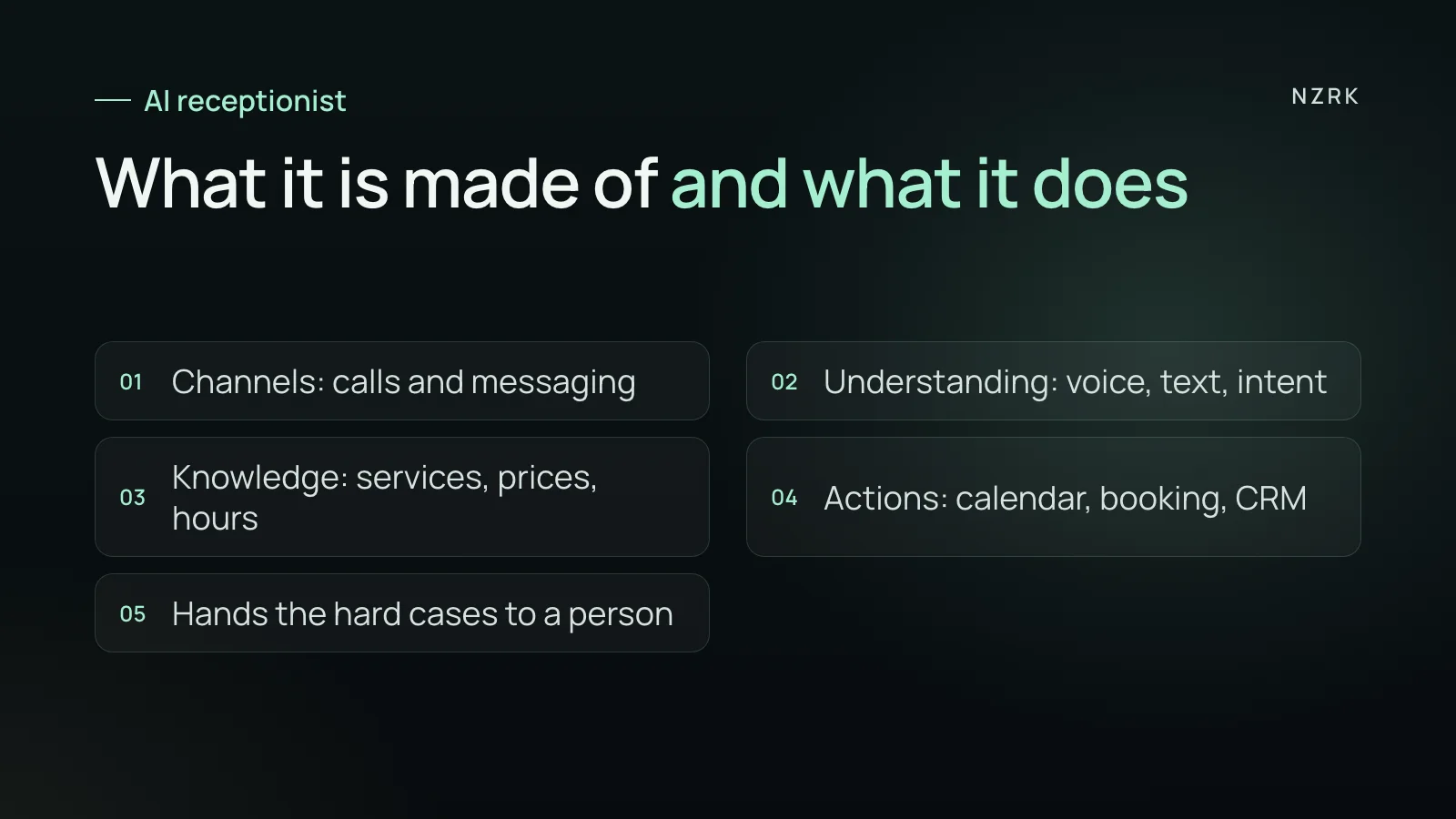
What it is made of
There are four parts inside. Knowing them helps you understand what you are paying for and what to test.
- Channels: your phone number, messaging apps and website chat. Customers reach you the same way they always have.
- Understanding: speech recognition turns voice into text, a language model works out what the caller wants, and speech synthesis speaks the reply.
- Business knowledge: services, prices, hours, address, preparation steps and answers to common questions. This is your own handbook, not general knowledge from the internet.
- Actions: finding free slots, creating the booking and logging the customer in your CRM. Also alerting the team and transferring the call to a person.
If one part is missing, the system works worse. Without knowledge it gives vague answers. Without calendar access it can only take a request, and a person still has to book it.
What one conversation looks like
A customer calls a hair salon at half past eight in the evening. The AI receptionist greets her and says straight away that it is the salon's AI assistant. She asks whether she can come in tomorrow after work.
The system checks the calendar, offers two open slots and names the stylists. She picks a time. The booking appears in the calendar, she gets a text confirmation, and a short call summary is saved in the CRM.
Say she asks about something outside the rules, such as a complaint about her last visit. The AI receptionist does not make up an answer. It says it will pass the question to the manager and sends the team a summary.
How it differs from tools you already know
- An answering machine only records a message. The caller waits for a callback and often just rings the next business on the list.
- A phone menu routes calls by keypad choice, but it does not understand free-form questions or book anything.
- A scripted website chat with buttons follows preset branches. It does not understand questions outside those branches.
- ChatGPT helps you write text and can connect to your calendar, but it does not answer customer calls on your phone line.
An AI receptionist combines understanding everyday speech with access to your data and your booking tools. A detailed comparison with a human hire is in AI receptionist vs human receptionist.
What it does well and what to keep with your staff
It suits repeat requests with a clear answer. That means prices, hours, directions, new bookings, reschedules, appointment confirmations and replies to missed calls.
Keep complaints, emotional conversations, medical or legal advice, one-off discounts and anything that needs the owner's decision with a person. A well configured system spots these conversations and transfers them with a short summary.
In the US and UK, rules on call recording consent and on health or personal data apply to these conversations. Check them with your adviser before launch, especially in healthcare.
Does your business need one? Six questions
Answer each one with an honest yes or no. The more yes answers, the more an AI receptionist will help.
- Customers call while your front desk is busy with someone in person.
- Messages from Instagram, WhatsApp and your website wait hours for a reply.
- Your team answers the same questions about prices, hours and directions every day.
- People call and message in the evening and on weekends when nobody is in.
- You do not know how many requests came in last week or how many became bookings.
- One person runs the booking diary, and without them it stops.
If you only have one or two yes answers, start simple: reply templates and a text back after a missed call. How to work out what an unanswered phone costs you is covered in our guide to missed calls.
What to prepare before launch
Most of the time goes into your rules, not the technology. Gather them early and launch goes faster.
- A list of services with duration, preparation and who performs each one.
- Booking rules: how far ahead, how to reschedule, what happens when someone is late.
- Your twenty most common customer questions and your answers.
- Topics that always go to a person, and to whom.
- Access to the calendar or CRM where bookings live.
You can take this list to any provider. To hear how this sounds in a live call, try the AI receptionist demo. LumaDent is our demo dental practice, so ask anything. Ways to pay for one are compared in our guide to AI receptionist cost.
How to test it before customers hear it
- Run ten test calls yourself: a normal booking, a reschedule, a price question, a complaint and an unclear request.
- Check that the system says it is an AI assistant at the start of each conversation.
- Ask for something that is not on your price list. The right behavior is to pass it to a person, not invent an answer.
- Look at what landed in the calendar and CRM after each conversation.
- Agree who on the team receives transferred conversations and how fast they reply.
For the first few weeks, read the conversation summaries daily. You will spot questions your handbook does not cover and can add them. An AI receptionist improves when you keep its knowledge up to date, not on its own.
Is an AI receptionist the same as a voice assistant?
A voice assistant is only one part. An AI receptionist usually covers calls, messages and calendar bookings together.
Will customers know they are talking to AI?
They should. An honest system says so at the start of the conversation, and you should check this before launch.
What happens if it does not know the answer?
A properly configured system does not guess. It offers to pass the question to a person and sends the team a summary.
Do I need a new phone number?
Not always. Often calls to your existing number are forwarded to the system when the front desk is busy or does not answer. It depends on your phone provider.