Who you are really replying to
The reviewer has already made up their mind, and winning them back in the comments rarely works. Your reply is read by others: people comparing you with competitors and scrolling reviews before they book. They are not judging who is right. They are watching how you behave when something goes wrong.
On Google Business Profile the owner can reply to a review as the business. The reply is posted publicly under the review, where anyone reading it can see it. So every reply is a small public statement about how you treat customers.
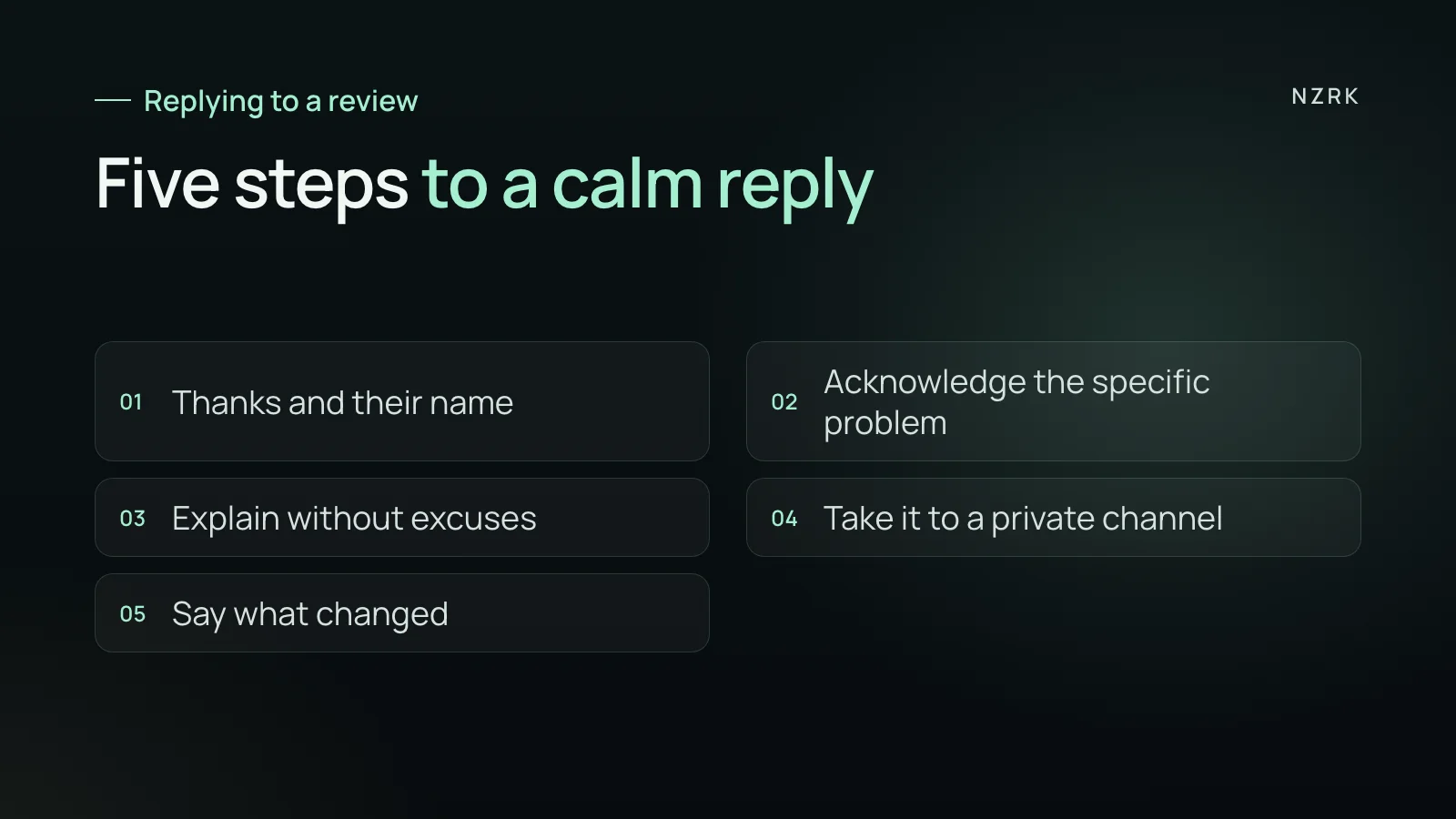
The five-step reply formula
- Thanks and name. Use the name the person left on the review and thank them for writing.
- Acknowledge the specifics. Restate the complaint in your own words: "you waited well past your appointment time". It shows you read it and did not paste a template.
- Explain without excuses. One sentence, and only if it adds something. "We had a busy day" sounds like an excuse, so leave it out.
- Take it offline. Give the phone number or email of a person who will deal with it and invite them to get in touch.
- What changed. One concrete action: wider gaps between bookings, a reminder before visits, a talk with the team.
Aim for three to five sentences. A long reply reads like an argument. A bare "Thanks for your feedback" reads like you do not care.
What never to write in a reply
- Do not argue or try to prove the customer wrong, even when they are.
- Do not share details: visit date, treatment, diagnosis, amount paid, or a staff name next to the case.
- Do not paste the same reply under every review. Identical replies in a row look careless.
- Do not offer a discount or gift in exchange for deleting the review.
- Do not reply in the heat of the moment. Later and calm beats fast and sharp.
For healthcare this rule is strict. Even "you visited us on the 12th" confirms that the person is your patient. In the US, the HHS Office for Civil Rights has settled with a dental practice over patient details in its review replies.
In the UK, GMC guidance says doctors must not make patient information public when responding to criticism, unless the patient explicitly agrees. Keep the reply general. Neither confirm nor deny that they were a patient, and move the conversation to a private channel.
Six templates for common situations
Two conditions before you copy a template. Only write actions like "we have reviewed our schedule" or "we talked with the team" if you actually did them. For healthcare, strip from the formula and templates anything that confirms a visit: appointment time, "with us", a clinician's name. Write "if you contacted us" instead.
Long wait or could not get through: "Thank you for writing, Emma. Waiting past your time or not getting through on the phone is frustrating, and that is on us. We have reviewed our schedule and how we answer calls. Please email us at [email] so we can offer you a time that works."
Unhappy with the result: "Thank you for the honest review, James. We want to understand exactly what went wrong. Please call our manager at [phone] and we will look into it and suggest a fix."
Rude staff: "Sarah, we are sorry you were spoken to that way. It should never happen. We have already talked with the team. If you are willing to share more, please email [email] and our manager will reply personally."
Felt too expensive: "Thank you for the feedback. We understand price matters. The cost depends on the work involved, and we always quote it before we start. If anything in the quote was unclear, email [email] and we will walk you through it line by line."
Not your customer: "Thank you for writing. We want to look into this. Please email [email] so we can check the details."
Some reviews show signs of breaking Google's policies: spam, fake content, abuse, someone else's personal data. You can report those in Business Profile. "This is not my customer" on its own usually does not count as a violation. Google removes reviews under its own rules, not because the owner asks.
One star, no text: "Thank you for the rating. We would like to know what we could do better. Please drop us a line at [email], it takes a minute."
What to do after you reply
- Pass the complaint to the person who can change the process, not only the one who replied.
- Log the reason in a simple sheet: date, channel, reason, what changed.
- Once a month, look for repeats. Two or three of the same complaint in a row point to a process problem, not one unhappy customer.
- Reply to positive reviews too. It makes the profile look active rather than defensive.
In a service business many bad reviews start before the service itself. The customer could not get through, waited too long for a reply in a chat, or never got a call back. If those reasons keep showing up in your sheet, look at AI customer service for calls, which also covers chats. It answers straight away and books into your calendar. Where else businesses lose customers before the first visit is covered in where businesses lose customers.
Do I have to reply to every negative review?
Ideally, yes. An unanswered complaint reads as if the business does not care. The exception is abuse or spam, which is better reported in Business Profile as a policy violation.
How fast should I reply?
The sooner the better, but not in anger. A good working rule: a calm reply within one or two business days beats an instant sharp one.
Can I ask the customer to delete the review?
You can ask them to update it once the problem is solved. Do not offer a discount or gift for removing it: Google's policies explicitly ban incentives to change or remove a review.