How a standard differs from a script
A script is the wording for your front desk. It covers how to greet, offer a time and pass on a difficult question. We cover one in receptionist phone script.
A standard is for the owner or practice manager. It answers a different question: does every call go through the right steps, whoever picks up the phone? Without one, a review sounds like "she seems fine on the phone". With one, you see exactly which step gets skipped and how often.
The core rule is that every point must be checkable. "Sounds friendly" is not a point, because everyone hears it differently. "Gave the practice name and their own name" is a point. You either hear it on the recording or you do not.
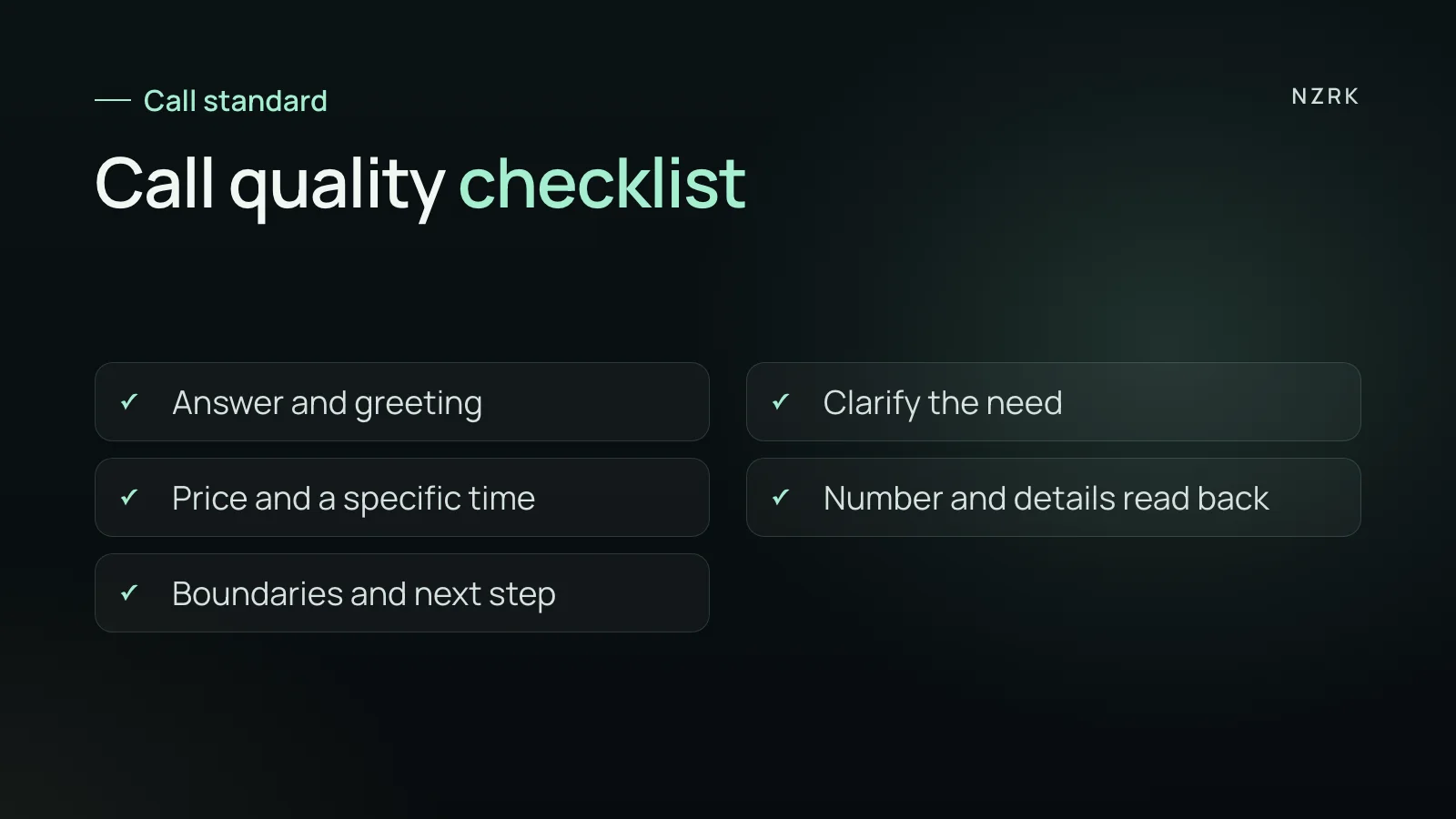
The 10-point checklist
The points follow the three parts of a call. Adjust the wording to your practice, but keep each one a question with a yes or no answer.
Opening the call:
- 1. The call was answered within your own standard. You set the threshold, for example by the third ring, and write it down.
- 2. The receptionist gave the practice name and their own name.
- 3. They clarified the need with one or two questions: what is the problem, which service, has the patient been in before.
Booking:
- 4. When the caller asked about price, they heard a price or a "from" range from your fee list. Not "come in and the doctor will tell you".
- 5. They offered a specific time instead of an open "when suits you?".
- 6. They took the name and phone number and read the number back.
- 7. At the end they repeated the details: date, time, clinician, address.
Boundaries and close:
- 8. No medical advice or diagnosis over the phone.
- 9. A complex question went to the person who can resolve it, with the patient's contact details. The caller heard when to expect a callback.
- 10. At the end the patient knows the next step. Booked, waiting for a call from the clinician, or calling back at an agreed time.
How to score a call
Each point gets yes, no or not applicable. If the patient never asked about price, point 4 does not apply to that call and is left out. The same goes for point 9 when there was no complex question.
Formula: call score = number of yes answers ÷ number of points that apply × 100 (as a percentage). Take the weekly score as the average across reviewed calls, and separately note which point gets a no most often. That point is the topic of your next coaching session.
Critical errors
Some mistakes matter more than any score. Agree in advance that such a call gets its own review, even if every other point was met.
- Medical advice or a diagnosis over the phone.
- A discount or promise nobody approved.
- Rudeness or hanging up on the caller.
- A patient in pain or with swelling did not get the earliest slot or clear guidance on where to go.
Which calls to review
If you only review the calls the receptionist picks, the picture can look better than it is. Mix your sample every week:
- First calls from new patients.
- Calls that did not end in a booking.
- Calls at peak hours, when the front desk is busy.
- Calls from each receptionist, if you have several.
Recordings usually live in your phone system. If you record calls, tell patients at the start of the call. In the US, consent rules for recording vary by state, and some states require every party to agree.
In the UK, a recording that identifies a person is personal data under UK GDPR. So tell callers and set a retention period. Recordings can also contain health information, so check retention and access rules with your compliance lead.
Missed calls never show up in the checklist, because there was no conversation. Track them separately: how many calls went unanswered and how many got a callback. We explain why in missed calls.
How to coach with it
- One point per session. Nobody remembers ten notes at once.
- Listen to the recording together instead of retelling it.
- Start with what went well and name it specifically: "here you clearly repeated the time and the address".
- Agree on one phrase the receptionist will say differently and add it to the script.
- A week later, check that exact point on new calls.
A standard is not a disciplinary tool. If a point keeps failing at peak hours, the cause may be workload rather than the person. The receptionist is handling a patient at the desk and the phone at once.
Spreadsheet template
To start today, a simple spreadsheet is enough. One row per call, with these columns:
- Date and time of the call, receptionist.
- Call type: new patient, existing patient, reschedule, question.
- Points 1-10: yes, no or not applicable.
- Critical error: yes or no.
- Score and one comment: what to fix first.
The same checklist for an AI receptionist
If a system answers some of your calls, score it on the same points and from the same recordings. A good AI receptionist should meet points 6, 8 and 10 just like a person. When a question falls outside its data, it should pass it to staff with the caller's name and number.
To hear how that sounds, you can talk to an AI receptionist demo and score the call with this checklist. LumaDent is our demo dental practice, not a client. Before booking, the demo reads the phone number back. When the practice data has no answer, it passes the question to staff with the caller's name and number. The demo does not give the address in its booking summary or say when the callback will come. So it scores a no on points 7 and 9.
How many calls should we review each week?
As many as the manager can review properly without rushing. A few varied calls every week beat a big batch once a month. That way you can see whether a change stuck after coaching.
Who should score the calls?
Whoever owns bookings: the owner, the practice manager or a senior receptionist. Receptionists can also score their own calls with the same checklist, which makes coaching easier.
Can we add our own points?
Yes, as long as each point is checkable in a recording and has a yes or no answer. Past about twelve points scoring gets hard, so replace a point rather than add one.
What if our calls are not recorded?
First check whether your phone system offers call recording. Until then, a manager can score live calls with the same checklist, though you will see less that way.